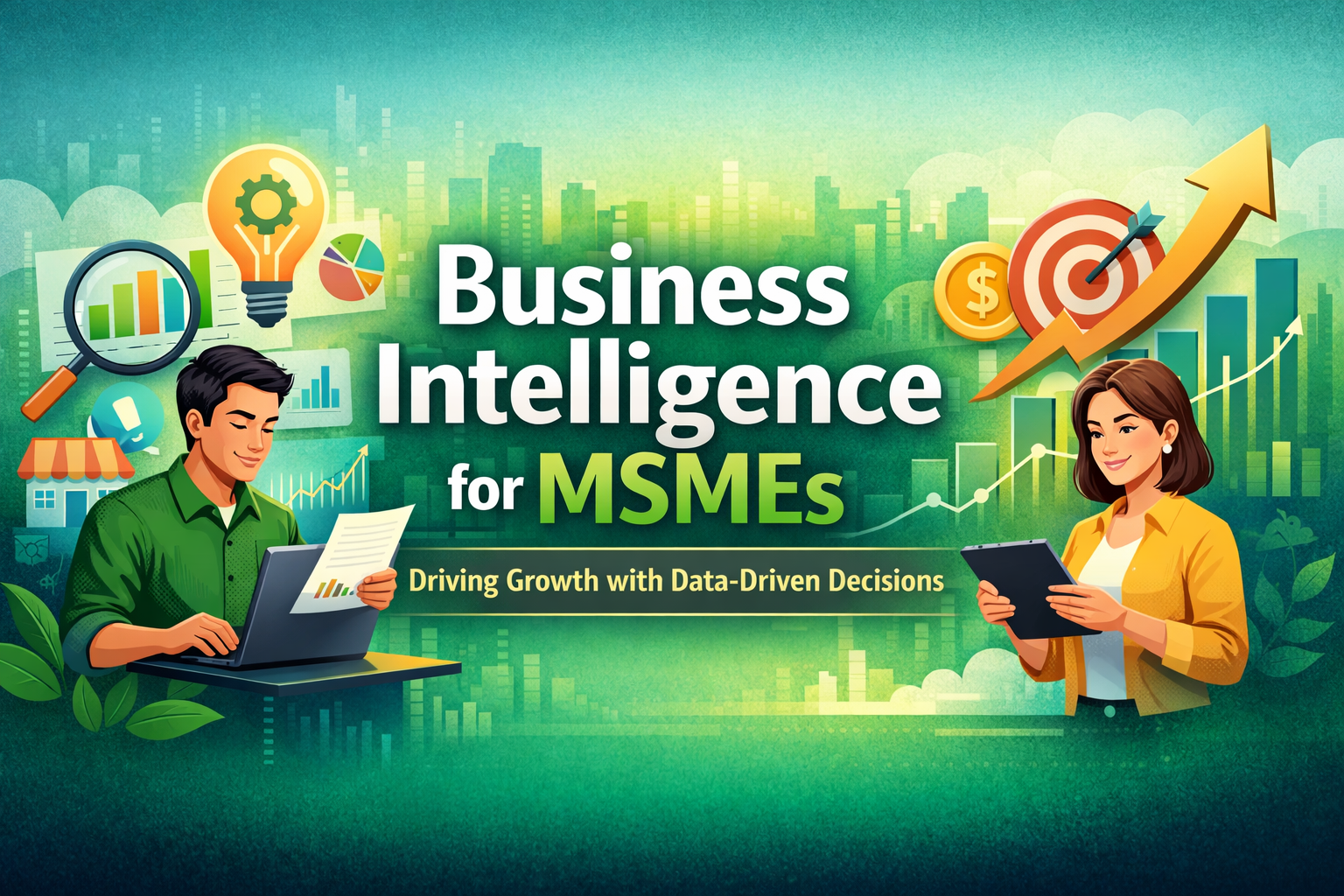
Business Intelligence for MSMEs
In today’s highly competitive digital economy, data has become one of the most valuable assets for businesses of all sizes. For Micro, Small, and Medium Enterprises (MSMEs), the ability to analyze data effectively can mean the difference between surviving and thriving. This is where Business Intelligence for MSMEs plays a crucial role. Business Intelligence, often referred to as BI, involves using tools and strategies to collect, analyze, and visualize data so that business owners can make informed decisions backed by real insights rather than assumptions.
What Is Business Intelligence and Why It Matters for MSMEs
Business Intelligence is a combination of processes, technologies, and tools that transform raw business data into meaningful information. For MSMEs, BI helps convert everyday data from sales, marketing, customer interactions, and operations into actionable insights. Instead of manually tracking performance through spreadsheets or guesswork, MSMEs can use BI platforms to view real-time dashboards and performance indicators.
The real value of Business Intelligence for MSMEs lies in its ability to identify trends, uncover hidden opportunities, and highlight potential risks. With accurate data, small businesses can respond faster to market changes, understand customer behavior, and optimize internal processes without requiring large IT teams or heavy investments.
Key Benefits of Business Intelligence for MSMEs
One of the biggest advantages of BI is improved decision-making. MSMEs often operate with limited resources, so every decision must be precise and impactful. BI enables owners and managers to rely on factual data rather than intuition. This results in better pricing strategies, smarter inventory management, and more effective marketing campaigns.
Another major benefit is enhanced operational efficiency. Business Intelligence tools can track workflow performance, identify bottlenecks, and highlight areas where costs can be reduced. By analyzing operational data, MSMEs can streamline processes and allocate resources more effectively.
Customer understanding is also significantly improved through BI. By analyzing customer data, MSMEs can identify buying patterns, preferences, and feedback trends. This allows businesses to personalize services, improve customer satisfaction, and build long-term loyalty.
How MSMEs Can Implement Business Intelligence
Implementing Business Intelligence does not require complex infrastructure. Many modern BI solutions are cloud-based, making them affordable and scalable for small businesses. MSMEs can start by identifying their business goals, such as increasing sales, reducing costs, or improving customer retention.
The next step is data integration. MSMEs should connect their sales systems, accounting software, CRM platforms, and digital marketing tools into a single BI dashboard. This creates a centralized view of business performance, eliminating data silos and improving visibility.
Once data is integrated, businesses can use BI tools to create dashboards that display key performance indicators. These dashboards provide instant insights into revenue, expenses, customer growth, and operational performance, helping MSMEs stay in control of their business.
Challenges in Adopting Business Intelligence
Despite its benefits, some MSMEs face challenges when adopting BI. Limited technical knowledge and fear of complexity are common concerns. However, modern BI platforms are designed with user-friendly interfaces, making them accessible even for non-technical users.
Data quality is another challenge. Business Intelligence is only as effective as the data it uses. MSMEs must ensure their data is accurate, consistent, and regularly updated to gain reliable insights.
Budget constraints can also be a barrier, but many BI tools offer flexible pricing plans and free trials. This makes it possible for MSMEs to adopt BI gradually without heavy upfront investments.
The Future of Business Intelligence for MSMEs
The future of Business Intelligence for MSMEs is closely linked to artificial intelligence and automation. Advanced BI systems now use AI to predict trends, recommend actions, and automate reporting. This allows MSMEs to focus more on strategy rather than manual data analysis.
As digital transformation continues, MSMEs that embrace BI will gain a competitive edge. Data-driven businesses are more adaptable, resilient, and capable of scaling in a rapidly changing market environment.
Final Thoughts
Business Intelligence for MSMEs is no longer a luxury reserved for large enterprises. It has become a necessity for small businesses seeking sustainable growth and long-term success. By leveraging BI tools, MSMEs can make smarter decisions, improve operational efficiency, and strengthen customer relationships. In an era where data drives innovation, adopting Business Intelligence is one of the most strategic investments an MSME can make to stay competitive and future-ready.