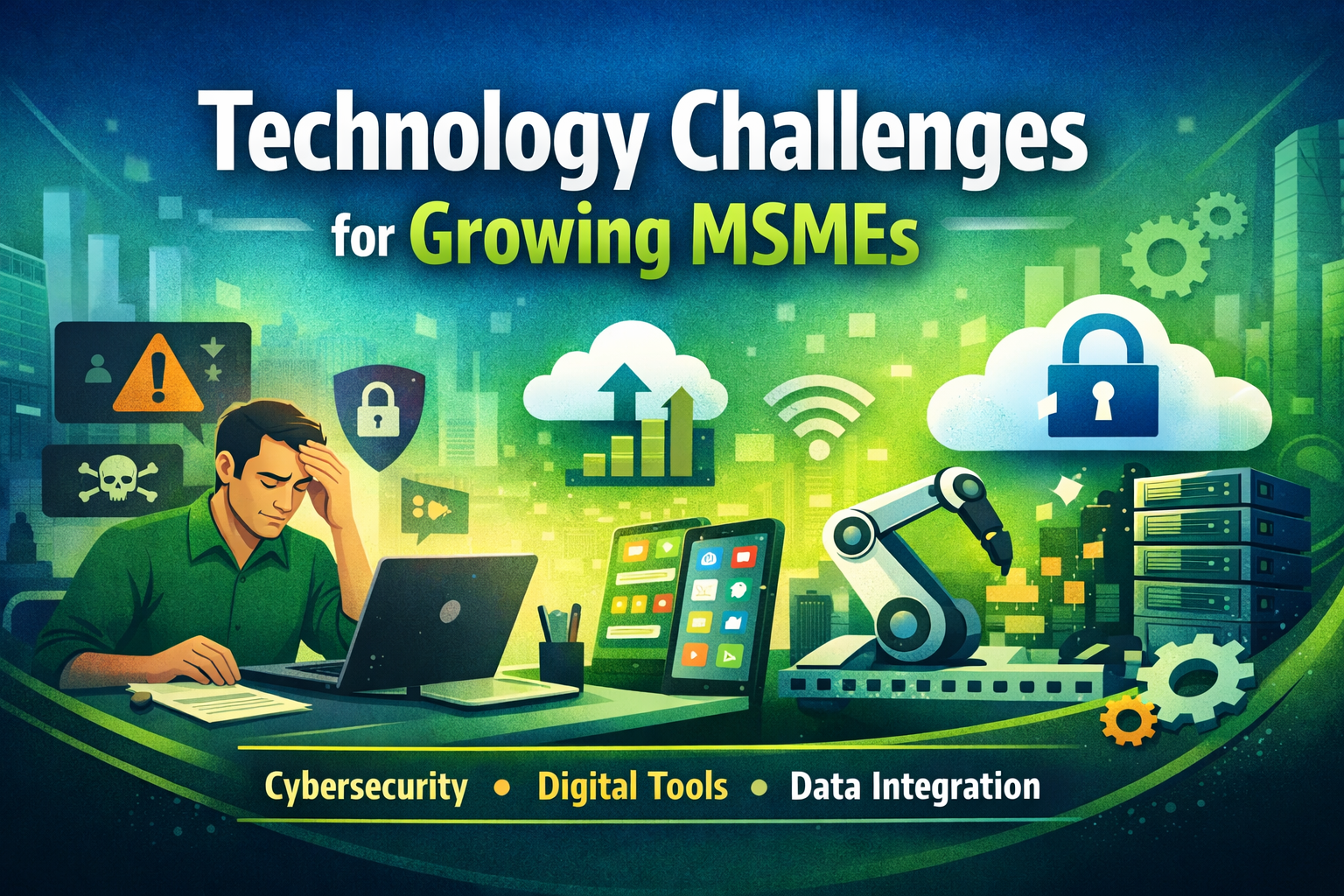
Technology Challenges for Growing MSMEs
Small and medium enterprises are the backbone of every developing economy. In India and across the world, MSMEs drive innovation, employment, and local growth. However, as these businesses expand, they face serious technology challenges that slow productivity, reduce efficiency, and increase costs. Understanding the technology challenges for growing MSMEs is the first step toward building a future-ready and scalable business.
In today’s digital economy, technology is no longer optional. It determines how fast you grow, how well you compete, and how secure your operations remain.
1. Limited Digital Infrastructure
Most MSMEs begin with basic tools like spreadsheets, WhatsApp, and manual billing systems. While these work in the early stages, they become unreliable when customer volume, inventory, and employees increase.
Without proper cloud platforms, CRM systems, or centralized data storage, businesses experience data loss, duplication, and errors. This creates confusion across departments and reduces decision-making accuracy.
Growing MSMEs need stable digital infrastructure, but budget and lack of awareness often delay this transition.
2. Cybersecurity Risks
As MSMEs move online, they become vulnerable to cyber threats. Many small businesses believe hackers only target big corporations, but in reality, MSMEs are easier targets due to weak security systems.
Common cybersecurity challenges include:
-
Phishing attacks
-
Data breaches
-
Ransomware
-
Weak passwords
-
No backup systems
A single cyberattack can destroy customer trust, leak financial data, and cause legal trouble. Investing in cybersecurity is no longer expensive; it is essential for survival.
3. Lack of Skilled IT Support
Hiring a full-time IT team is expensive for most MSMEs. As a result, technology issues remain unresolved or are handled by untrained staff. This leads to slow systems, broken workflows, and security gaps.
Without skilled technical support, businesses struggle with:
-
Software setup
-
Server management
-
Data backup
-
System upgrades
-
Integration between tools
This creates downtime and frustration that directly affects revenue.
4. Poor Software Integration
Many MSMEs use multiple disconnected tools for accounting, inventory, sales, payroll, and customer management. When systems do not talk to each other, data has to be entered manually.
This causes:
-
Duplicate data
-
Human errors
-
Delayed reporting
-
Inaccurate stock levels
Integrated digital platforms allow businesses to automate operations and get real-time insights, but selecting the right tools remains a challenge.
5. High Cost of Technology Adoption
Enterprise-level software often comes with high subscription fees, long contracts, and complex setups. For growing MSMEs, these costs become a burden.
Because of budget limitations, many businesses continue using outdated systems that cannot scale. However, affordable cloud-based tools and no-code platforms are now changing this landscape, making digital transformation accessible even for small enterprises.
6. Resistance to Change
One of the biggest technology challenges for growing MSMEs is mindset. Employees and even business owners often resist switching from traditional methods to digital systems.
This fear of change leads to:
-
Low adoption of new tools
-
Poor training
-
Underutilized software
-
Reduced ROI
Successful MSMEs focus on training and awareness, making technology simple and useful for their teams.
7. Data Management Issues
As businesses grow, data increases rapidly. Sales records, customer information, invoices, and inventory details pile up. Without structured databases and cloud storage, finding accurate data becomes difficult.
Poor data management results in:
-
Bad business decisions
-
Compliance issues
-
Missed sales opportunities
-
Customer dissatisfaction
Digital data systems bring clarity and help MSMEs grow smarter.
How MSMEs Can Overcome These Challenges
Modern solutions such as cloud computing, automation tools, no-code platforms, and AI-powered systems make technology adoption easier than ever. MSMEs should focus on:
-
Cloud-based accounting and ERP
-
Secure data storage and backups
-
Business automation
-
Mobile-friendly systems
-
Cybersecurity awareness
By starting small and scaling gradually, businesses can achieve digital growth without financial stress.
Conclusion
The technology challenges for growing MSMEs are real, but they are not impossible to solve. In fact, businesses that embrace digital transformation early gain a strong competitive advantage.
With the right tools, training, and strategy, MSMEs can operate faster, serve customers better, and grow sustainably in the modern economy. Technology is not just a support system anymore—it is the engine of business growth.