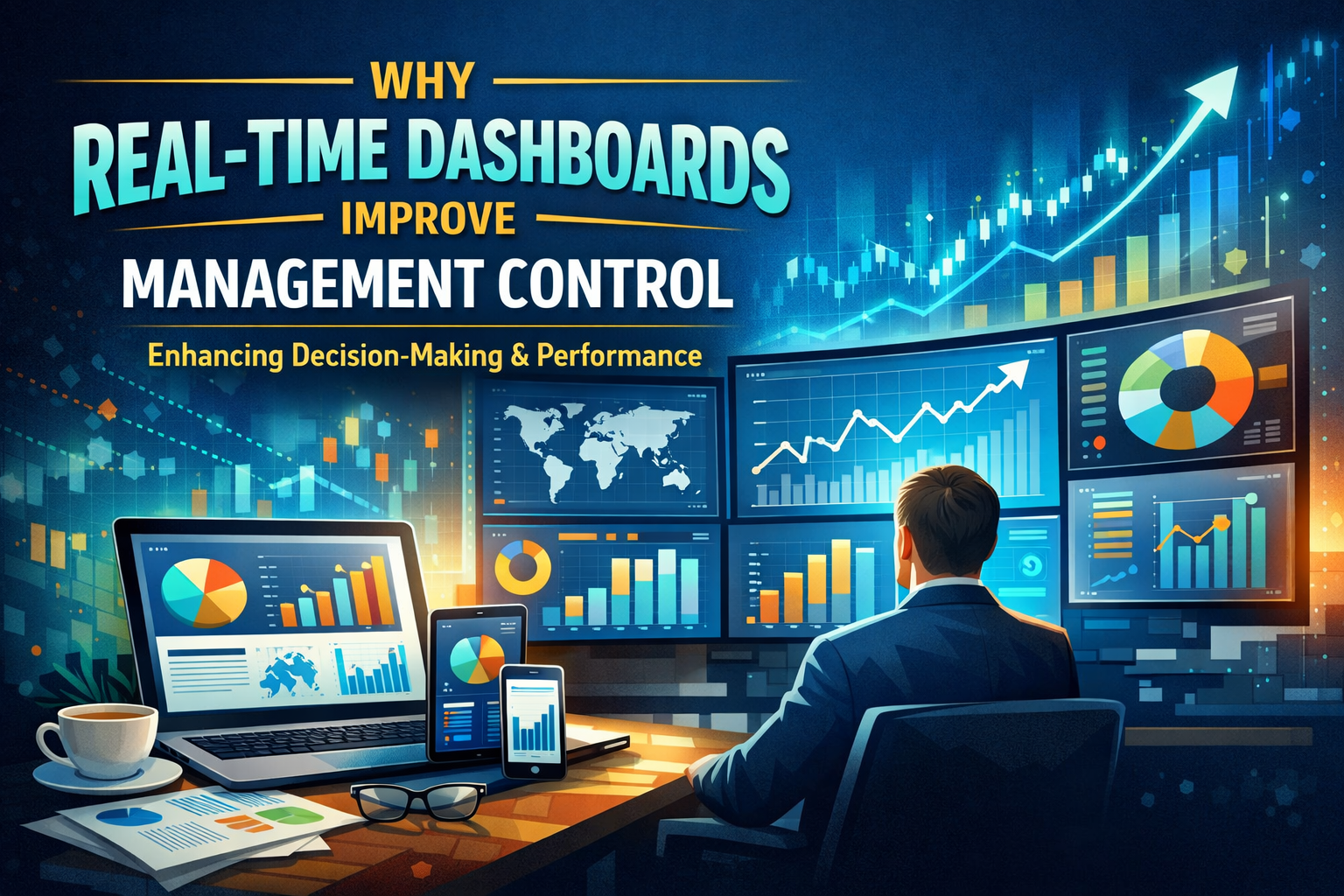
Why Real-Time Dashboards Improve Management Control
In today’s fast-moving business environment, relying on end-of-day reports or weekly summaries is no longer enough. Managers need instant visibility to stay in control. This is exactly why real-time dashboards improve management control across industries, especially for growing MSMEs and operations-driven businesses.
A real-time dashboard consolidates live data from different departments—production, sales, inventory, finance, or operations—into one clear visual screen. Instead of waiting for updates, decision-makers can act the moment something changes.
Instant Visibility Eliminates Blind Spots
Traditional reporting systems often create delays. By the time a report reaches management, the damage may already be done. Real-time dashboards eliminate this gap by showing live metrics as they happen.
When management can instantly see production output, material consumption, pending orders, or daily expenses, there are fewer blind spots. This visibility ensures that issues like stock shortages, production delays, or cost overruns are identified early—before they grow into serious problems.
This instant awareness is one of the biggest reasons why real-time dashboards improve management control.
Faster Decisions Lead to Better Control
Management control is not about having more data—it’s about having the right data at the right time. Real-time dashboards support faster decision-making by presenting key performance indicators in a simple, visual format.
Instead of asking teams for updates or checking multiple spreadsheets, managers can take immediate action. Whether it’s reallocating manpower, stopping unnecessary expenses, or addressing low productivity, decisions become proactive rather than reactive.
Speed in decision-making directly translates to stronger control over business operations.
Accountability Becomes Clear and Measurable
One major challenge in management is accountability. When data is delayed or scattered, it becomes difficult to assign responsibility. Real-time dashboards solve this by linking actions to live data.
When production numbers drop or costs increase, the dashboard clearly shows when and where the deviation occurred. This creates transparency across teams and encourages employees to stay disciplined with daily reporting.
As a result, management gains better control without micromanaging.
Leakage Control Improves Automatically
Many businesses lose money through small, unnoticed leakages—extra material usage, unrecorded expenses, idle machine time, or missed follow-ups. These leakages often go unnoticed due to delayed reporting.
Real-time dashboards highlight anomalies instantly. If material consumption suddenly spikes or expenses cross a threshold, alerts can notify management immediately. This early detection helps businesses plug leakages before they impact profitability.
This practical benefit strongly proves why real-time dashboards improve management control in real-world scenarios.
Single Source of Truth for Management
Without dashboards, data usually exists in multiple files, registers, or systems. This creates confusion and conflicting reports. Real-time dashboards act as a single source of truth.
All stakeholders—owners, managers, and supervisors—see the same numbers. This alignment reduces internal disputes and ensures that discussions are based on facts, not assumptions.
When everyone works from the same data, management control becomes stronger and more consistent.
Scalability Without Complexity
As businesses grow, complexity increases. Managing multiple units, shifts, or locations becomes difficult with manual tracking. Real-time dashboards scale effortlessly by adding new data sources without increasing confusion.
Management can monitor growth without losing control, making dashboards a long-term solution rather than a temporary tool.
Conclusion
In a competitive and data-driven world, control comes from visibility, speed, and accuracy. This is why real-time dashboards improve management control far better than traditional reporting methods. They empower leaders to act faster, reduce leakages, improve accountability, and maintain clarity across operations.
For businesses aiming to scale sustainably, real-time dashboards are no longer optional—they are essential.